Biology ss1 term 3
Biology ss1 term 3
Biology ss1 term 3
AQUATIC HABITAT: MARINE
CONTENT
- Meaning of Aquatic Habitat
- Types of Aquatic Habitat
- Major Zones of a Marine Habitat
- Distribution of the Organisms in the Habitat and their Adaptive Features
Meaning of Aquatic Habitat
An aquatic habitat is a body of water in which organisms live. Such organisms are called aquatic organisms e.g. fish, algae, crabs, etc.
Types of Aquatic Habitat
There are three types of aquatic habitat namely:
- the marine/salt water habitat;
- the estuarine/brackish water habitat and
- the freshwater habitat.
Marine Habitat
The marine habitat is a body of salty water. It is made up of the shore and open sea. Examples are the oceans and seas.
Characteristics of Marine Habitat
- High salinity; about 35.2 parts of salt per 1000 parts of water.
- High density of about 1.028; this enables organisms float in it.
- Pressure increases with depth.
- It is the largest of all habitats. It occupies over 70% of Earth’s total area.
- There is action of waves.
- There is tide actione. alternate rise and fall in level of sea water twice a day.
- The water is alkaline with pH of 8.0 – 9.0 near the surface
- Oxygen concentration decreases with depth.
- Light penetration decreases with depth.
- Currents are always produced by winds at the surface of the ocean.
Biology ss1 term 3 third term
EVALUATION
- What is a marine habitat?
- State five characteristics of a marine habitat.
Major Zones of a Marine Habitat
It has two major zones, the
(i) Littoral zone
(ii) Benthic zone
(i) Littoral Zone (Continental shelf)
This zone is sub divided into:
(a) splash zone
(b) intertidal zone
(c) sub-tidal zone
(a) Splash zone: this zone is just above the high tide mark, and is wetted by the spray from breaking wave. It has occasional moisture since it is the area where water splashes when the waves break at the shore.
(b) Intertidal zone: This covers the shoreline between the high and low tides. The zone is covered with water during high tide and exposed to air during low tide. This happens twice daily. The zone is exposed to wave action and has high photosynthetic activities because of abundant sunlight
(c) The Sub-tidal zone: This is the zone that extends over the continental shelf to a depth of about 200metres. The zone experiences more variations in temperature, water turbulence, salinity and lightning more than any other zone. It is the main site of commercial fish harvest. Its high productivity is attributed to its richness in nutrients, a large part of it being in the lighted (photic) part of the ocean.
(ii) Benthic zone (Continental slope)
Biology ss1 term 3 third term
This zone is characterized by:
(a) Benthic zone: This consists of the deep water that extends beyond the continental shelf, from about 500m to the very depths of the ocean. It has very low light penetration and low nutrients.
(b) Pelagic or abyssal zone: This zone is about 3000m, and has low light penetration, high pressure, low photosynthetic activities and the primary production of food is by chemosynthesis.
(c) Hadal or aphotic zone: It is the deepest zone, ranging from 7000m. The water is dark and cold, i.e. no light penetration, and on photosynthetic activities.
EVALUATION
- Mention the two major zones of the marine habitat.
- What are the characteristic features of each zone?
Biology ss1 term 3 third term
Distribution of the Organisms in the Habitat and their Adaptive Features
- Splash zone/Shore organisms: On rocky shores, periwinkles and shore slaters are found in the area that water splashes when waves break (also called splash zone). Barnacles, oysters, mussels and limpets are found on the intertidal zone of the rocks. Anemones, sponges and seaweeds are found on sheltered parts of rocks. Sea urchins, sea cucumbers and seaweeds are found in rock crevices. Most of these organisms have adhesive structures so as to be able to withstand wave and tide action.
Examples:
(i) Sargassum (a seaweed) is attached to rocks by holdfasts.
(ii) Barnacles are cemented to the rocks
(iii) Limpets have feet with which they hold unto rocks.
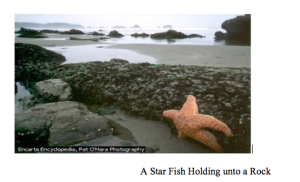
Sandy shore organisms include starfish, ghost crabs, bivalves and annelids. Their major adaptation is to burrow into the sand so as to escape being washed away by waves and tides.
(i) The shell of the starfish prevents it from drying up and it has tube feet which enable it to hold onto rocks.
(ii) Periwinkles have lungs to breath and foot for attachment.
(iii) The ghost crab has gills for breathing in water and a spongy structure for breathing on land.
(iv) Crabs can burrow into the mud quickly to protect themselves against predators, strong waves and tides.
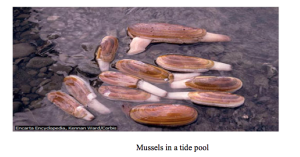
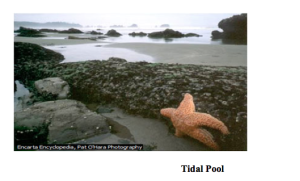
Mussels in a tide pool
- Intertidal organisms: These include bivalves, mollusks, barnacles, anemones, worms, etc. These organisms face the challenge of exposure and drying out. To overcome this;
(i) Barnacles, mollusks and worms on rocky areas withdraw into their shells or tubes which hold some water.
(ii) Bivalves have special feet for digging into the sand or mud.
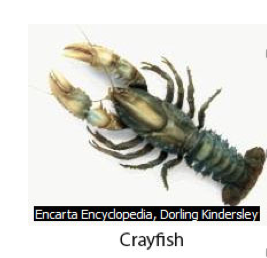
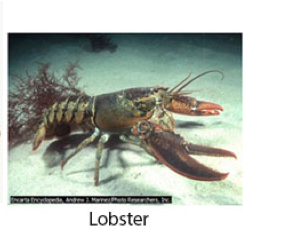
- Sub-tidal organisms: These include lobsters, crayfish and fishes like the sting ray and sole.
The sting ray’s body is flattened from top to bottom and so it lives on the sea floor. The sole is also flat, it lies on its lower side and has both eyes on the upper side. These fishes lie buried in the sandy sea floor and hunt for small animals there.
The lobsters and crayfish have claws for seizing prey.
- Benthic organisms: These are mainly consumers and decomposers. Fishes that live in the deep sea are adapted to live under conditions of great pressure. Some have expandable mouths and stomachs for swallowing large prey. Most live on dead remains of organisms from surface waters above.
Biology ss1 term 3 third term
The open waters support planktons and nektons.
Planktons are microscopic organisms which float, drift or swim slowly on the surface waters. They include producers like diatoms and seaweeds and consumers such as protozoa, copepods, worms, larvae and mollusks. Adaptations of planktons that help them stay afloat include; oil globules inside the body; gas-filled external floats and bubble rafts; external spines and hair which (provide friction and prevent sinking).
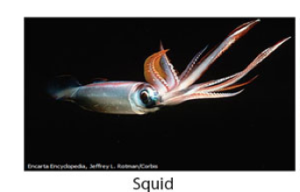
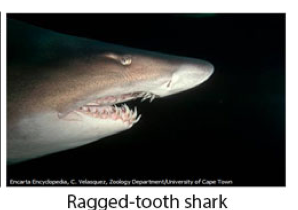
Nektons are actively swimming animals e.g. fishes, whales, prawns and squids. Adaptive features of fishes include;
(i) a streamlined muscular body coupled with fins which help them move swiftly in water.
(ii) bony fishes have gas-filled swim bladders which help them to move to different depths in water.
(iii) Sharks and dogfish have the ability to retain urea in their body to cope with high salinity.
(iv) The herring take in salt water to maintain osmotic balance between their tissue fluids and the salt water.
(v) Some bony fishes possess salt secreting glands in their gills for osmoregulation.
Biology ss1 term 3 third term
EVALUATION
- Mention four organisms found in the marine habitat.
- Identify two organisms in the Benthic zone and state their adaptive features.
AQUATIC HABITAT: ESTUARINE
CONTENT
- Meaning of Estuarine Habitat
- Characteristics of Estuarine Habitat
- Types of Estuary
- Distribution of the Plants and Animals in Estuarine Habitat
- Adaptive Features of the Plants and Animals in the Estuarine Habitat
- Food Chain in Estuarine Habitat
Biology ss1 term 3 third term
Meaning of Estuarine Habitat
An estuarine habitat is an ecological zone where river and sea water meet, thus to establish brackish conditions. Brackish water has a salinity which fluctuates with the tides and the wet and dry seasons. It is neither salt water nor freshwater, but the intermediary between both. It occurs where freshwater interact with salt water.
Characteristics of Estuarine Habitat
Some characteristics of estuarine habitat include:
- It has a fluctuating salinity
- It has Poor aerated substratum or saturated soil that lack oxygen.
- There is mild wave action.
- There is high and low tidal influence.
- Soil erosion is prominent.
- It is exposed and prone to flood periodically.
Biology ss1 term 3 third term
EVALUATION
- Define estuarine habitat.
- Outline three characteristics of estuarine habitat.
Types of Estuary
- Mashes
- Deltas
- Lagoons
- Bay
- Swamps
- Marshes: Brackish water marsh is usually found in intertidal areas which are periodically flooded and drained by the tides. They are especially common along the coastal areas near estuaries.
- Deltas: this is where a river divides into many channels before entering into oceans or sea. it is formed at the mouth of a river as it enters the sea.
- Lagoon: a body of ocean water that enters into the land through a canal therefore has the opportunity of mixing with fresh water from rivers and streams.
- Bay: it is a small body of sea water which enters into land and mixes up with fresh water from rivers and streams.
- Swamps: a swamp is wetland with vegetation found in temperate and tropical regions. Brackish water marsh is usually found along coastal areas or intertidal areas which are periodically flooded and drained by the tides.
Types of Estuary based on Salt Mixing
Biology ss1 term 3 third term
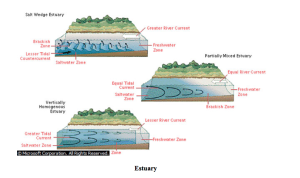
The following are the types of estuary based on salt mixing:
- Salt wedge estuary.
- Vertically homogeneous estuary.
- Partially mixed estuary.
Biology ss1 term 3 third term
This diagram illustrates the three main types of estuarine mixing. Tides, wind, wave motions, and river runoff all contribute to create various water conditions within estuaries. Salt wedge estuaries, such as the Mississippi Delta, exist where the river current exceeds the tidal current. Equal river and tidal currents, such as those in the Chesapeake Bay, create a partially mixed estuary. Where the tidal range exceeds the freshwater inflow, as in the Bay of Fundy, mixing is more complete and a vertically homogenous estuary is created.
EVALUATION
- Mention three types of estuary.
Distribution of Organisms in an Estuary
Plants: We have
- Red mangrove, Rhizophora sp. which is the main species of flowering plant in the lagoons or estuaries and
- White mangrove, Avicennia sp. occur in areas of higher salinity and drier land than the red
- Plankton protists such as diatoms, and flamentous algae.
- Fern plant, Acrostilchumaureum (the only fern able to withstand salt water) grows in this habitat, so also are
- Numerous grasses (paspalum sp.)
Animals: We have
- Invertebrates: Mitten crabs, starfish, arenicola, mudskipper, lancelet and barnacles. The animals commonly found in the estuaries or lagoons are those that can withstand salinity variations and they include the bloody clam, common lagoon crab, hermit crab, the hairy mangrove crab, the fiddler crab, cichlids, the prawns, Ethmalosa, Arins, and the grey mullet (Mugil).
- Birds: Such birds as the herons, waders and palm nut vulture are found here.
- Mammals include bats and monkeys.
Adaptations of Estuarine Organisms
Adaptations of Plants
White mangrove has breathing roots to permit intake of atmospheric air and their leaves can excrete salts.
The red mangrove has still roots to enable it to withstand strong ocean winds
To ensure development of the seedlings and to avoid being swept off by ocean current, some seeds germinate on the parent plant.
Adaptations of Animals
Crabs have air-breathing lungs-like structures for breathing.
Starfish have tube feet to hold fast.
Barnacles and starfish have shell- like covering to protect them from drying up.
Food Chain in Estuarine Habitat
- Diatoms → Small fish → Shark → Man.
- Detritus → Shrimp → Fish → Bird.
Biology ss1 term 3 third term
EVALUATION
- List some organisms of the brackish water.
- Write two each of the adaptation of plants and animals in estuarine habitat.
- Write a short note on the types of estuarine with examples.
- List five types of freshwater bodies.
- Briefly explain three types of estuary.
FRESH WATER HABITAT
CONTENT
- Characteristics of Freshwater Habitat
- Types of Freshwater
- Zones in Fresh Water Habitat
- Fresh Water Organisms
- Adaptation of Organisms to Fresh Water
Biology ss1 term 3 third term
Characteristics of Freshwater Habitat
The freshwater habitat includes the lakes, ponds, streams, springs, and rivers. These water bodies are known for low salt content or low salinity. The animals and plants in freshwater habitat vary from the ones in the estuarine habitat. This is due to the salinity factor.
Some characteristics of freshwater habitat include:
- It has low salt content.
- Relatively small body of water.
- The water is shallow.
- Its temperature varies with depth and season.
- Low density water.
- Turbidity depends on season.
- There is available oxygen in all parts of water but more at the surface.
- Freshwater habitat accommodates bony fishes like tilapia.
Types of Freshwater
Freshwater is divided into two broad types:
- Stagnant water (lentic): Pools, pond, puddles, and lakes.
- Running water (lotic): Springs, streams, and rivers.
Biology ss1 term 3 third term
If you need all the content at an affordable price (N500) ONLY, feel free to contact us.
+2348039740135 : whatsapp
Are you a school owner or a teacher,
Click the image below to join Teachers’ Connect to learn more…

YOUR COMMENTS ARE WELCOME
If you need all the content at an affordable price (N500) ONLY, feel free to contact us.
+2348039740135 : whatsapp
Are you a school owner or a teacher,
Click the image below to join Teachers’ Connect to learn more…
YOUR COMMENTS ARE WELCOME