biology ss2 third term
biology ss2 third term
biology ss2 third term
REPRODUCTIVE SYSTEMS IN VERTEBRATES
CONTENT
(B) Reproductive Systems in Bird and Mammals
- Structures of the Male and Female Reproductive Systems
- Parts of the Reproductive Systems and their Functions
- Structures of the Male and Female Gamete (Sperm and Ovum)
- Differences between Male and Female Reproductive Organs
Reproductive Systems in Vertebrates
The male reproductive system of birds (cock) consists of a pair of testis found near the kidneys. A sperm duct runs down from each testis and opens into the cloaca. Sperms cells accumulate at the end of the sperm duct.
As the male cloaca gets in contact in the female during mating, sperm cells are transferred into the female.
A typical female bird (pigeon) has only the left ovary which is located anterior to the kidney. Different sizes of follicles are found in the ovary. The left oviduct is large and wide-mouthed funnel with thick wall and a coiled duct leads into the uvodeum.
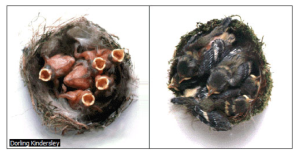
A torrent of food—the result of as many as 1000 daily foraging trips by the parents—helps the chicks of many tree-dwelling birds grow from featherless, blind, helpless nestlings into self-sufficient animals within three weeks. A brood of blue tit chicks is shown here at 3 and 13 days of age, at which time they are fully capable of flight.
The male reproductive system in mammals consists of the following:
The male sex organs are the testis. These are in pairs and are contained in the scrotal sacs, outside the body in order to keep them under a temperature lower than 370C for optimum production of sperms. Sperms are produced in the semimiferous tubules of the testis and are stored in the tubes of the epididymis. The sperms then travel through the sperm duct (vas deferens) to the urethra. Liquid nutrient is added to the sperm from the seminal vesicles and the prostate gland to form the semen. During mating (intercourse), the semen is discharged into the female vagina through the penis.
The female sex organs are called ovaries which are inside the abdomen. These produce eggs which are released into the opening of the oviduct and moved in to the opening of the oviduct and move down the funnel with the aid of the cilia in the oviducal funnel. The oviduct leads to the uterus or the womb. Humans have a single uterus while rats have a double uterus. A fertilized egg is retained in the uterus where it becomes embedded in the wall. The vagina leads from the uterus to the outside of the body. The cervix lies at the end of the uterus and this closes after fertilization to avoid further entrance of sperms and foreign bodies.
EVALUATION
- What is significant about the testis and ovaries in the reproductive system of mammals?
- Mention 3 parts of the female reproductive system in birds.
Parts of the Reproductive Systems and their Functions.
Reproductive System of Birds and Functions of the Parts
Male and Female Birds
| PART | FUNCTION | ||
| 1. | Testes | Production of sperm cells. It carries and accumulates sperms, Point of transfer of sperms. |
|
| 2. | Ovary, Follicle, and Oviduct |
Production of eggs. Contains the immature ovum, and coiled duct that leads into the urodeum. |
|
Some Parts of the Reproductive Systems of Mammals and their Functions
Male Reproductive System of Mammals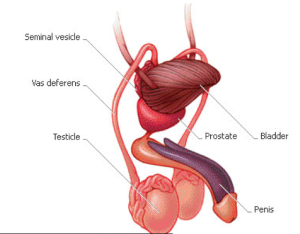
Male Reproductive System
The organs of the male reproductive system enable a man to have sexual intercourse and to fertilize female sex cells (eggs) with sperm. The gonads, called testicles, produce sperm. Sperm pass through a long duct called the vas deferens to the seminal vesicles, a pair of sacs that lies behind the bladder. These sacs produce seminal fluid, which mixes with sperm to produce semen. Semen leaves the seminal vesicles and travels through the prostate gland, which produces additional secretions that are added to semen. During male orgasm the penis ejaculates semen.
- The Testes: This contains coiled tubules called seminiferous tubules in which actively dividing cells produce the male gametes-sperm cells. The testes also stores the sperm produced in addition to the production of sex hormones- testosterone. This hormone is responsible for the development of male secondary sexual characteristics.
- Vas deferens: This is the sperm duct which continues from the epididymis. It serves as the pathway through which the sperm run from the epididymis to the urethra.
- Penis: This is made up of spongy erectile tissue which is a sensitive urinogenital organ. The penis, when erected, discharges semen through the female vagina into the oviduct.
- Prostate gland: secretes substances that help to energise and transport the sperms
- Cowper’s gland: secretion from this gland help to normalise the alkaline concentration of the sperm.
biology ss2 third term
Parts of the Female Reproductive System of Mammals and their Functions
- Ovary: The ovaries contain several thousands of potential eggs called primary Ooccytes. The ovaries produce the female gametes.
- Oviduct: Released eggs are received by a funnel like structure known as the fallopian tube or the oviduct which serves as a pathway for the passage of ovum fertilisation occurs in the oviduct. Oviduct opens to the uterus.
- Uterus: This is a muscular structure connected to the outside or exterior through the vagina. Its glandular lining serves to nourish the embryo in the early stages of development. Its smooth muscles in the walls greatly increase in number during pregnancy. Contraction of the uterus eventually expels the foetus and its placenta during birth.
- Cervix: This lies at the ventral and of the uterus. It usually closes after fertilization to avoid further entrance of sperms and other foreign bodies.
- Vagina: This serves as the receptor of sperm cells ejaculated by the male.
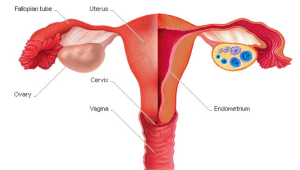
biology ss2 third term
Female Reproductive System
The bones of the human female pelvis form a bowl-shaped cavity that supports the weight of a developing fetus and encloses the organs of the female reproductive tract. Two ovaries, the female gonads, produce mature eggs. Leading away from the ovaries are the fallopian tubes, or oviducts, the site of fertilization. The uterus, a muscular organ with an expandable neck called the cervix, houses the developing fetus, which leaves the woman’s body through the vagina, or birth canal.
Structure of the Male and Female Gametes
The basic structures of the male and female gametes in mammals are as follows:
The Male Gamete
The human (mammalian) gamete is shaped like tadpole made up of a head with a nucleus and a tail (flagellum) the sperm is about 60 micrometers long, is microscopic and usually smaller than the female gamete.
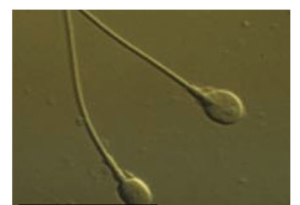
Two Human Sperm Cells
The small capsule-shaped head of the sperm cell contains the chromosome contribution from the male. The whiplike tail helps to propel the sperm cell toward the egg, where fertilization takes place.
EVALUATION
- What is the function of the sperm duct in male birds?
- Why is the mammalian male penis described as a urine genital organ?
- By what means are sperms transformed from the male bird to the female.
biology ss2 third term
The Female Gamete
The human (mammalian) female gamete is also microscopic but is larger than the sperm. The ovum as it is called is about 0.1mm in diameter. It consists of the cytoplasm, a central nucleus, granules and yolk droplets. The yolk serves as a source of nourishment for the embryo in its early developmental stages. The cytoplasm of the ovum is surrounded by a double membrane. The inner membrane is the plasma membrane while the outer one is viteline membrane. The ovum is bounded on the outside by a jelly coat of variable thickness made up of glycoprotein. The nuclei of both the male and female gametes contain chromosomes that carry the genes which are responsible for passing on parent’s characteristics to the offspring.
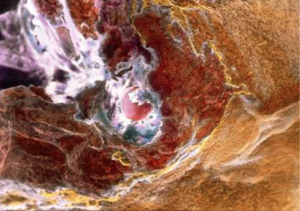
Ovary Releasing an Ovum
The ovary is the female organ that produces the reproductive cells called eggs, or ova. This false-color electron micrograph shows the release of a mature ovum at ovulation. The ovum (red) is surrounded by cells and liquid from the ruptured ovarian follicle.
EVALUATION
- Draw and label the male gamete of a mammal.
- What is the function of the Nucleus in the male and female gametes?
- Describe the structure of the female gamete in mammals.
Differences between Male and Female Reproductive Organs
There are differences and similarities when the male and female reproductive organs are compared.
biology ss2 third term
| S/N | MALE REPRODUCTIVE ORGAN | FEMALE REPRODUCTIVE ORGAN | |
| 1. | Testes are in scrotal sacs located outside the body. |
Ovaries are located inside the body |
|
| 2. | Epididymis present | Epididymis absent | |
| 3. | Sperm produced by testes | Egg produced by ovaries | |
| 4. | Sperm cells pass out through the urethra |
Ova pass into the oviduct where they are fertilised |
|
| 5. | Sperm duct present | Sperm duct absent | |
| 6. | Seminal vesicle present | Seminal vesicle absent | |
| 7. | Prostate gland present | Prostate gland absent | |
| 8. | Cowper’s gland present | Cowper’s gland absent | |
| 9. | Penis present | Penis absent | |
| 10. | Oviduct absent | Oviduct present | |
| 11. | Uterus absent | Uterus present | |
| 12. | Vagina absent | Vagina present | |
| 13. | Cervix absent | Cervix present | |
| 14. | Vulva absent | Vulva present |
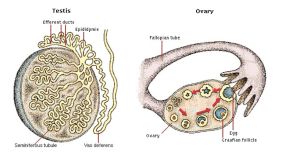
Structure of Human Gonads
Gonads—in the male, the testes (singular, testis), and in the female, the ovaries—are the organs that produce gametes and sex hormones. The male gamete is the spermatozoan, produced by cell division in the seminiferous tubules of the adult testes. Typically, several hundred million sperm reach maturity in the epididymis and are stored in the vas deferens each day. Whatever is not released in ejaculation is reabsorbed, part of a continuous cycle. In the female, the ovaries produce eggs, or ova. At birth, about 2 million oocytes, or immature eggs, are present in the ovaries. Once the female reaches puberty, one egg matures approximately every 28 days inside a saclike Graafian follicle. Ovulation occurs when the mature egg bursts from the follicle and the ovary, beginning its journey down the fallopian tube toward the uterus.
biology ss2 third term
Similarities in the Male and Female Reproductive Organs
For similarities: Both reproductive organs have;
- Gonads or sex organs (testes and ovaries).
- Gametes are produced by gonads.
- Have external opening.
- Have gonads acting as ductless (endocrine) glands.
EVALUATION
- Mention three (3) differences between the male and the female reproductive organs.
- Mention three (3) similarities found in the comparison of male and female reproductive organs.
- In what way does male reproductive organ function as an endocrine gland?
- State the functions of the following parts of the reproductive systems of birds, mammals, fish (a) Claspers (b) Uterus (c) Cloaca (d) Oviduct (e) Seminal vessicle (e) Ovum.
- Briefly discuss the structural differences in the male and female gametes of mammals.
- State four similarities and five (5) differences between the reproductive organs of male and female mammals.
COMPARISON OF REPRODUCTION IN VERTEBRATES
CONTENT
- Structural Differences in the Eggs of Vertebrates
- Comparison of Reproduction in Fish, Reptiles and Mammals
Structural Differences in the Eggs of Vertebrates
The fish eggs are very small and appear like mass of sand grains. The egg contains the young fish and is enclosed in and egg case or membrane. In amphibians- toad or frog, the eggs are small and spherical. An egg consists of semi liquid cytoplasm containing a nucleus surrounded by a tough black egg membrane. The toads egg is black on the under surface because the protoplasm of the egg is full of yolk granules abundant in the lower part of the eggs.
The egg has a thin coat which absorbs water and swells to form the jelly or albumen. This jelly protects the egg and separates them from one another in a bead-like manner.
In reptiles, e.g., Agama lizard. The egg is cream coloured. It has a soft but tough leathery shell. It absorbs water from the surrounding soil and increase in size or volume.
The egg of the bird is the largest single animal cell. Its porous shell allows for the exchange of gases with the egg and its environment. The egg possesses two membranes enclosing the albumen. The albumen contains the yolk in which the germinal disc or embryo occupies the inner most core.
The mammalian egg is microscopic and is about 0.1mm in diameter. It consists of the cytoplasm, a nucleus in the centre, granules and yolk droplets. The yolk provides a source of nourishment for developing embryo. The ovum (egg) is surrounded by two membranes. The inner one is the plasma membrane while the outer one is the vitelline membrane.
If you need all the content at an affordable price (N500) ONLY, feel free to contact us.
+2348039740135 : whatsapp
Are you a school owner or a teacher,
Click the image below to join Teachers’ Connect to learn more…

YOUR COMMENTS ARE WELCOME