Mathematics ss1 term 3
Mathematics ss1 term 3
Mathematics ss1 term 3
Logical Reasoning
Mathematics ss1 term 3 First term
CONTENT:
- Simple statements.
- Meaning of simple statement – (i) True or false (ii) negation of simple statements.
- Compound statements (i) Meaning (ii) Conjunction (iii) Disjunction (iv) Implication (v) bi-implication.
- Logical operators and symbols. (i) List of logical operators and symbols (ii) Truth value of logical operators.
SIMPLE STATEMENTS
Logic is the science of thinking about or explaining the reason for something. It is a particular method or system of reasoning which arrive at conclusions by way of valid evidence.
Mathematical logic can be defined as the study of the relationship between certain objects such as numbers, functions, geometric figures etc. .
Example: The following are logical statements;
- Nigeria is in Africa
- The river Niger is in Enugu
- 2 + 5 = 3
- 3 ≤ 7
(N.B The educator should ask the students to give their examples)
Example: The following are not logical statements because they are neither true nor false.
- What is your name?
- Oh what a lovely day
- Take her away
- Who is he?
- Mathematics is a simple subject (note that this statements is true or false depending on each individual, so it is not logical).
Educator to ask the students to give their own examples.
THE MEANING OF SIMPLE STATEMENT
Statements are verbal or written declarations or assertions. The fundamental (i.e logical) property of a statement is that it is either true or false but not both. So logical statements are statements that are either reasonably true or false but not both
True or False Statements
To determine the truth or falsity of a simple statement, one requires pre-knowledge and/or definition of the main concepts related to the statements. For example, the simple statement ‘it is hot’ is true if ‘it’ refers to a hot object or weather. Otherwise the statement is false. A true statement is said to have a truth value T while a false statement is said to have a truth value F.
Example: Indicate T or F for the truth value of each statement.
- 10two is equal to 10
- Green is one of the colours on the Nigerian flag
- How far is Abuja from here?
- 3 {2, 4, 6, 8, …}
- The perimeter of a room 2.5m by 3.5m is 6m
Solution:
- F
- T
- Not applicable
- F
- F
(note: educator to explain closed statements and open statements as in question 3)
NEGATION OF SIMPLE STATEMENTS
The opposite of a statement is called the negation of the statement. Given any logical statement P, the negation (or the contradiction or the denial) of P is written symbolically as P
Examples: Write the negation of each of the following statements.
- I am a Mathematician
- 2>4
- 15<12
- x+1≥4
- The sky is the limit
Solution:
- I am not a mathematician
- 2≯4
- 15≮12
- x+1≤4 or x+1≥4
- The sky is not the limit
Truth table for P:
| P | ~P | |
| T | F | |
| F | T |
Mathematics ss1 term 3 First term
Class Activity:
Write the negation of the following statements:
- All polygons are quadrilaterals
- It is a sunny day
- XYZ is an isosceles right angled triangle
- The figure is a cube
- X is not a prime number
Compound statements:
When two or more simple statements are combined, we have a compound statement. To do this, we use the words: ‘and’, ‘or’, ‘if … then’, ‘if and only if’, ‘but’. Such words are called connectives.
Conjunction (or ˄) of logical statements:
Any two simple statements p,q can be combined by the word ‘and’ to form a compound (or composite) statement ‘p and q’ called the conjunction of p,q denoted symbolically as p˄q.
Examples:
- Let p be “The weather is cold” and q be “it is raining”, then the conjunction of p,q written as p˄q is the statement “the weather is cold and it is raining”.
- The symbol ‘˄’ can be used to define the intersection of two sets A and B as follows:
A∩B=x:x∈A˄x∈B
The truth table for p˄q is given below:
| P | Q | P˄Q | |
| T | T | T | |
| F | F | F | |
| T | F | F | |
| F | T | F |
Class Activity:
Form compound statements using ‘and’, and express the following compound statements in symbol form.
- P: It is cold.
Q: It is wet.
- P: x+3
Q: x=–3
- P: f(x)=5x2+2
Q: f(1) = 7
- P: (x+2)2 is a perfect square
Q: When x=1, (x+2)2=9
Disjunction (or ˅) of logical statements
Mathematics ss1 term 3 First term
Any compound statement formed by using the word ‘or’ to combine simple statements is called a disjunction. The symbol ‘˅’ stands for ‘or’.
Examples
- Let `p ‘ be “Bola studied Mathematics”, and `q’ be “Ngozi studied French”. Then the disjunction of p, q (p˅q) is the statement “Bola studied Mathematics or Ngozi studied French”.
- P: You will read your notes.
Q: You will fail
P˅Q: You will read your notes or fail
- P: x+1=2
Q: x=1
P˅Q: x+1=2 or x=1
- P: The solution of x2–2x–15=0 is 5
Q: The solution of x2–2x–15=0 is −3
P˅Q: The solution of x2–2x–15=0 or −3
The truth table for p˅q is illustrated below
| P | Q | P˅Q | |
| T | T | T | |
| F | F | F | |
| T | F | T | |
| F | T | T |
Class Activity:Express the compound statements in symbolic form.
- P: 2–√ is a rational number, Q: 2–√ is an even number.
- P: the trade union is stubborn, Q: the workers strike will soon be ended.
- P: 5 is a prime number, Q: 7 is an even number.
- P: a person who has taken physics can go to geophysics, Q: a person who has taken geology can go for geophysics.
Mathematics ss1 term 3 First term
Implications (conditional statements)
When the connective ‘if…then’ is used to combine simple statements, the result is called an implicative or conditional proposition. We denote implication symbolically by ⇒ i.e p⇒q means if p is true, then q is true. (or p implies q or p only if q, etc.)
Examples: Form compound statements using ‘if … then’
- P: The triangle is an equilateral triangle
Q: The angles are equal
P ⇒ Q: If the triangle is equilateral then the angles are equal.
- P: −∞<x<10
Q: 100<x2<∞
P ⇒ Q: If −∞<x<10 then 100<x2<∞
- P: Isa is a Mathematician .
Q: He is intelligent.
P ⇒ Q: If Isa is a mathematician then he is intelligent.
N.B :Educator to explain antecedent and consequent and Examples should be given.
The truth or falsity of the implication P Q: is shown below:
| P | Q | P ⇒ Q | |
| T | T | T | |
| F | F | F | |
| T | F | T | |
| F | T | T |
Class Activity:
Form compound statements using ‘if … then’
- P: y=2
Q: y2=4
- P: A student reads Mathematics
Q: The student reads science
- P: Damilola is a youth corper
Q: she has a degree
- Identify the antecedent and consequent in the statement below:
If Mathematics teachers work very hard then they will be compensated.
Bi-implication or Bi-conditional statement (equivalence):
Another common statement in Mathematics is of the form “p if and only if q”. This statement is actually the combination of two conditional statements and so it is called bi-conditional or equivalence and is denoted by p↔q or sometimes p iff q (if and only if) i.e implies and is implied by.
Examples: 1. Let p be “he is a handsome man” and q be “10 > 6” then p↔q is the statement “he is a handsome man if and only if 10 > 6”, then p↔q is the statement. He is a handsome man if and only if 10 > 6
- P: A number is divisible by 3
Q: The sum of the digits of the number is divisible by 3
P↔Q: A number is divisible by 3 iff the sum of its digits is divisible by 3
The truth table for p↔q is shown below:
| P | Q | P ↔ Q | |
| T | T | T | |
| T | F | F | |
| F | T | F | |
| F | F | T |
Logical operators and symbols
The word ‘not’ and the four connectives ‘and’, ‘or’, ‘if … then’, ‘if and only if’ are called logic operators. They are also referred to as logical constants. The symbols adopted for the logic operators are given below.
| Logic Operators | Symbols | |
| ‘not’ | − or ~ | |
| ‘and’ | ∧ | |
| ‘or’ | ∨ | |
| ‘if…then’ | → | |
| ‘if and only if’ | ↔ |
When the symbols above are applied to propositions p and q, we obtain the representations in the table below:
| Logic Operation | Representation | |
| ‘not P’ | ~P or p ̅ | |
| ‘P and Q’ | P∧Q | |
| ‘P or Q’ | P∨Q | |
| ‘if P then Q’ | P→Q | |
| ‘P if and only if Q’ | P↔Q |
PRACTICE EXERCISE:
- What are the Truth values of this compound statement? ~(P ˄ ~Q)
- Determine the truth value of the compound statement (S ⇒ R) ˄ ~R
- Use a truth table to prove that; ~(P ⇒ Q) ↔ (P ˄ ~Q) is a Tautology.
- Copy and Complete the table below:
| P | Q | ~Q | P ⇒ Q | P ˅~Q | (P ⇒ Q) ↔ (P˅~Q) | |
| T | T | |||||
| T | F | |||||
| F | T | |||||
| F | F |
- If P and Q are two logical statements, copy and complete the following truth table
| P | Q | P˅Q | ~(P˅Q) | (P˅Q) ˄ ~Q | ~(P˅Q) ⇒~P | |
ASSIGNMENT:
- If P and Q are two logical statements, copy and complete the following truth table
| P | Q | P ˅ Q | ~(P ˅ Q) | (P ˅ Q) ˄ ~P | ~(P ˅ Q) ⇒ (~P ˄~Q) | |
- Study the following:
- Antecedent
- Consequent
- Converse, inverse and contrapositive statements
- Tautology and contradiction
Trigonometry 1
Mathematics ss1 term 3 First term
CONTENT:
(a) Basic Trigonometric Ratios: (i) Sine (ii) Cosine (iii) Tangent with Respect to Right-angled Triangles.
(b) Trigonometric Ratio of: (i) Angle 300 (ii) Angle 450 (iii) Angle 600.
Basic Trigonometric Ratios (i) Sine (ii) Cosine (iii) Tangent with respect to right-angled triangles.
These trigonometric ratios are applicable to right – angled triangle. A right – angle triangle is 900. Thus the remaining two angles add up to 900 since every triangle contains two right angles.
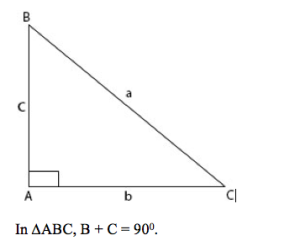
Such angles whose sum is 900 are said to be complementary angles. While capital letter are used for angles, small (lower case) letters are used for sides. Notice that the side opposite A is labelled a, the one opposite B is labelled b etc.
The side opposite the right angle is called the hypotenuse. Every right – angled triangle obeys the Pythagoras theorem. This theorem states that the square of the hypotenuse of any right angled triangle is equal to the sum of the square of the other two sides.
Thus in the above triangle, a^2 = b^2 + c^2
Apply Pythagoras theorem to the right – angled triangles below to find the lettered sides.
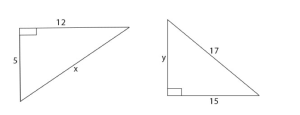
There are six basic trigonometric ratios viz: sine, cosine, tangent, cosecant, secant and cotangent. The first three are commonly used.
They are applicable only to right – angled triangles. Their short forms are: Sin, Cos, tan, cosec, sec, and cot respectively.
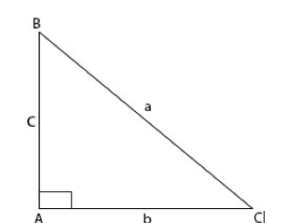
In the figure above,
Sin B = \frac{\text{opposite of B}}{\text{hypotenuse}} = \frac{b}{a} \\ Sin C = \frac{\text{opposite of C}}{\text{hypotenuse}} = \frac{c}{a}
In short, sine = \frac{\text{opposite}}{\text{hypotenuse}}
Mathematics ss1 term 3 First term
Similarly,
Cos B = \frac{\text{adjacent side to B}}{\text{hypotenuse}} = \frac{c}{a} \\ Cos C = \frac{\text{adjacent side to C}}{\text{hypotenuse}} = \frac{b}{a}
In short, cosine = \frac{\text{adjacent}}{\text{hypotenuse}}
Also, Tan B = \frac{\text{opposite of B}}{\text{hypotenuse B}} = \frac{b}{c} \\ Tan C = \frac{opposite of C}{\text{hypotenuse C}} = \frac{c}{a}
In short, tan = \frac{\text{opposite}}{\text{adjacent}}
Using the first letter of these three words of three formulae, we have SOH CAH TOA
SINE
The trigonometric ratio sine, is opposite divided by hypotenuse. Its reciprocal is cosecant.
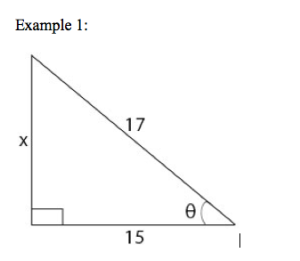
Find sin θ in the above figure.
Solution
Sin θ = \frac{\text{opposite side of θ}}{\text{hypotenuse}}
The opposite side of θ is not given. By using Pythagoras theorem, it can be found.
Let the opposite side to θ be x
By Pythagoras theorem
x^2 + 15^2 = 17^2 \\ x^2 + 225 = 289 \\ x^2 = 289 – 225 \\ x^2 = 62 \\ x = 8 \\ Sin θ = \frac{\text{opposite side of θ}}{\text{hypotenuse}} = \frac{8}{17}
Example 2:
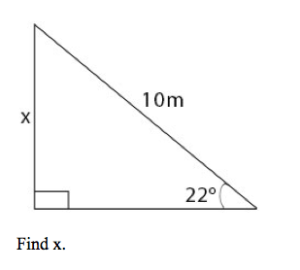
Find x.
Solution
Since the opposite of the given angle is known and the hypotenuse of the triangle, one can use sine ratio.
sin 22^o = \frac{x}{10m} \\ x = 10m × sin 22^o \\ = 10m × 0.3746 \\ = 3.746m
Class Activity:
- Find SinB, SinC in the figure below.
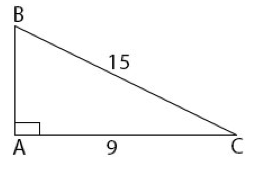
- In right – angled triangle XYZ, with Z = 900. If l XY l = 5m and l YZ l = 3m. Find (i) Sin x (ii) y
- If a ladder of length 2m leans against a wall and makes 300 with the floor, how high above the floor does the ladder reach on the wall?
COSINE
The trigonometric ratio cosine is adjacent divided by hypotenuse. Its reciprocal is secant.
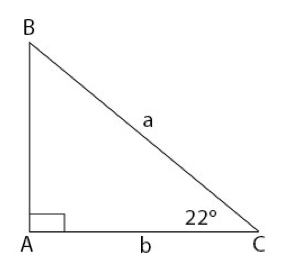
In the triangle above, B and C are complementary Sin B = \frac{b}{a} = Cos C
Also, Sin C = \frac{c}{a} = Cos B
For complementary angles, the sine of one is the cosine of the other i.e.
Sin θ = Cos (90 – θ)
Example 1:
Solve Sin 2x = Cos3x
Solution:
Mathematics ss1 term 3
Since Sin θ = Cos (90 – θ)
So, Sin 2x = Cos (90 – 2x) …….(i)
But we are given that
Sin 2x = Cos3x …….(ii)
From the right hand sides of equation (i) and (ii) we conclude that
90^o – 2x = 3x \\ 90^o = 5x
So, x = \frac{90}{5} = 180^o
Example 2.
The angle of elevation of the top of a tree is 600. If the point of observation is 4m from the foot of the tree. How far is the point from the top of the tree?
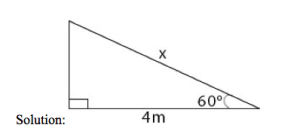
Let the point of observation from the top of the tree be x metres.
Cos 60^o = \frac{4}{x} \\ 0.5 = \frac{4}{x} \\ 0.5x = 4 \\ x = \frac{4}{0.5} = 8m.
Example 3.
Given that Cos x = 0.7431, 0 < x < 900, use tables to find the values of (i) 2sinx (ii) tan x/2
Solution:
Cos x = 0.7431 \\ x = cos^{-1} 0.7431 \\ 42^o.
(i) 2Sinx = 2Sin42^o \\ 2 (0.6691) = 1.3382
(ii) Tan = \frac{x}{2} = Tan \frac{42}{2} \\ = Tan 21^o \\ = 0.3839
Class Activity:
- Find the unknown sides of the following triangles.
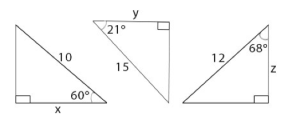
- If sin θ = 0.3970 use the tables to find (i) cos 2θ (ii) tan 3θ
TANGENT
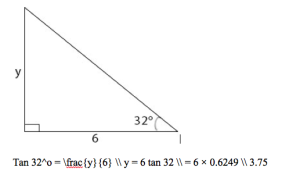
Tan = \frac{\text{opposite}}{\text{adjacent}}
Example 1:
Find y in the figure below
 Mathematics ss1 term 3
If you need all the content at an affordable price (N500) ONLY, feel free to contact us.
+2348039740135 : whatsapp
Are you a school owner or a teacher,
Click the image below to join Teachers’ Connect to learn more…

YOUR COMMENTS ARE WELCOME